
 Sunil Gill
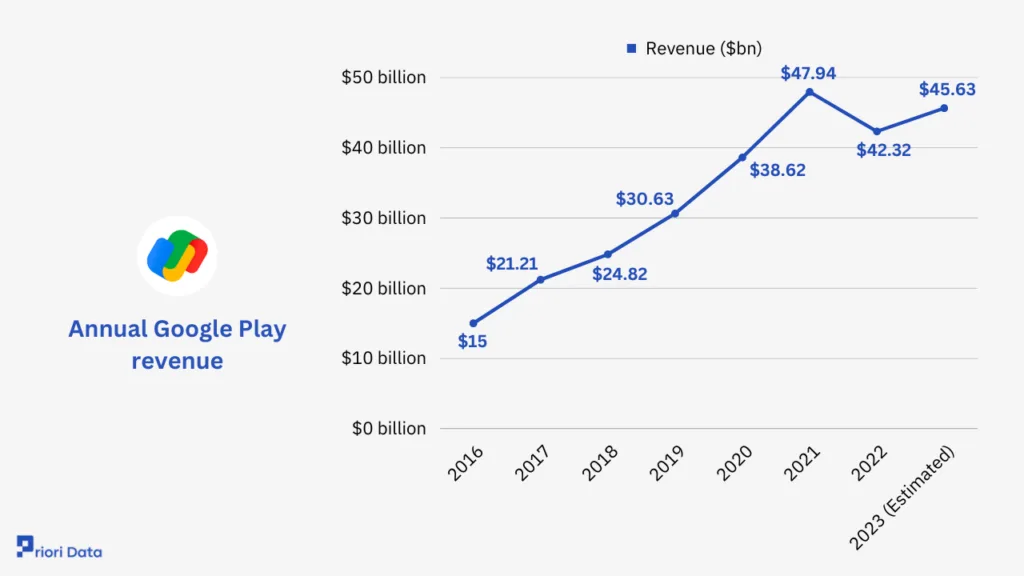
Google Play has more than 2.5 billion monthly active users in over 190 countries, carried more than 140 billion downloads in its last reported year and has paid developers more than $120 billion since it opened, according to Google's own description of the store. What Google does not publish is Google Play's revenue. Alphabet folds it into a reporting line with YouTube subscriptions and hardware, so every Google Play revenue figure you will see is an outside estimate.
This report gives the figures Google states, the market totals from the two analytics firms that model both stores, Google's fee structure, and a clear line between measured and estimated numbers.
Google Play statistics: the key figures
- More than 2.5 billion monthly active users across 190+ countries (Google).
- More than 140 billion downloads in the last year, and over $120 billion paid out to developers to date (Google).
- 2.01 million apps on Google Play as of October 2026 (AppBrain), which Google rounds to "2 million apps and games".
- $155.8 billion spent in apps across the App Store and Google Play in 2025, up 21.6%, on 106.9 billion downloads (Appfigures). Sensor Tower's model puts it at $167 billion and nearly 150 billion downloads.
- Google's service fee is 15% on the first $1 million a developer earns each year and on subscriptions, and 30% above that, with a new structure in the US, UK and EEA from June 30, 2026.
- Non-game apps out-earned games across both stores in 2025 for the first time (Sensor Tower and Appfigures).
Google Play revenue: what is known and what is estimated
Alphabet reports a line called "Google subscriptions, platforms, and devices" that combines Google Play, YouTube subscriptions and Pixel hardware. Google Play's own consumer spending is not broken out anywhere in Alphabet's filings. The closest official statement is cumulative: more than $120 billion paid to developers since the store opened in 2012, which is what remains after Google's fee.
For annual figures you are relying on analytics firms, and they agree on the shape even where they differ on the totals:
| Both stores, 2025 | Appfigures | Sensor Tower |
|---|---|---|
| Consumer spending | $155.8 billion, up 21.6% | $167 billion, up 10.6% |
| Downloads | 106.9 billion, down 2.7% | Nearly 150 billion, up 0.8% |
| Games spending | $72.2 billion (46%) | Less than apps for the first time |
| Non-game spending | $82.6 billion, up 33.9% | Up 21% |
The two firms count re-downloads and third-party Android stores differently, which is why their download totals are 40 billion apart. Neither publishes a free, verified split between the stores for 2025, but their estimates have consistently put Google Play at roughly a third of combined consumer spending and well over half of downloads. Treat any precise Google Play revenue figure as that firm's model.
Users and downloads
Google's figure of more than 2.5 billion monthly active users is the one it has used on its "How Google Play works" page for several years without an update, so it is a floor rather than a current count. Android runs 69% of the world's smartphones by web traffic, and Google Play is the default store on nearly all of them outside China, where Google services are absent and local Android stores take its place.
View as table
| Period | Value |
|---|---|
| Games | $72.2B |
| Non-game apps | $82.6B |
Source: Appfigures, 2025 year in review, via TechCrunch
Google's "140+ billion downloads in the last year" sits comfortably above either firm's estimate for both stores combined, which is a reminder that Google counts installs and updates differently from the way analysts count first-time downloads. The figures are not comparable, and the download totals on this page should be read as rankings rather than as an audit.
Apps on Google Play
AppBrain, which tracks the store's catalogue, counted 2,010,562 apps on October 6, 2026. The number was over 3 million before 2023; the fall reflects Google's removal of low-quality and abandoned apps and stricter policies for new developers, including the testing requirements for personal accounts created after November 2023. Fewer apps has not meant fewer downloads.
Google's service fee
| Transaction | Fee, most markets |
|---|---|
| First $1 million a developer earns each year | 15% |
| Earnings above $1 million a year | 30% |
| Auto-renewing subscriptions | 15%, regardless of earnings |
| Eligible media and other program participants | 15% or lower |
From June 30, 2026 in the US, UK and EEA, and September 30, 2026 in Australia and Japan, Google applies a different structure in which the fee depends on whether the user installed the app before or after that date, with lower rates for new installs. Google says 97% of developers pay no fee at all because they sell nothing through the store, and that 99% of those who do pay are eligible for 15% or less. The 2026 changes follow court rulings and regulatory pressure in each of those markets, and the details are in Google's service fee page.
What the numbers mean for app developers
- Google Play is where the users are and the App Store is where the money is. Two and a half billion monthly users produce about a third of consumer spending; plan Android for reach and iOS for revenue, and expect the gap in revenue per user to be large.
- Downloads are flat or falling across both stores while spending grows by double digits. The market now rewards keeping and converting users, not acquiring them.
- Non-game apps passed games in 2025. Subscriptions, and in particular AI apps, are the reason, and Google Play's 15% subscription rate makes it the cheaper store for that model.
- The fee you pay now depends on the country and on when your user installed. Model it per market rather than assuming 15% or 30%.
Which apps lead the download charts is in the most popular apps report, and the fees in context of a pricing decision in the guide to app monetization.
How these figures are counted
Google's user, download, payout and country figures are from its "How Google Play works" page and are not dated by Google. AppBrain counts apps in the public Play catalogue daily. Appfigures and Sensor Tower estimate downloads and spending from their own panels and store data; their figures cover iOS and Google Play together and exclude third-party Android stores. The service fee schedule is from Google Play Console Help as of October 2026.
FAQs
How much revenue does Google Play make?
Google does not say. Alphabet reports Google Play inside a line that also includes YouTube subscriptions and devices. Google states that developers have earned more than $120 billion from the store to date. Analytics firms estimate Google Play at roughly a third of the $156 to $167 billion spent across both stores in 2025.
How many apps are on Google Play?
About 2.01 million as of October 2026, according to AppBrain. Google itself says "2 million apps and games". The total has fallen from over 3 million as Google removed low-quality apps.
How many people use Google Play?
More than 2.5 billion monthly active users in over 190 countries, according to Google. The figure has not been updated for several years, so the current number is likely higher.
What percentage does Google Play take?
15% on a developer's first $1 million of earnings each year and on all subscriptions, and 30% above $1 million, in most markets. From mid-2026 the US, UK, EEA, Australia and Japan use a structure where the fee depends on when the user installed the app.
Which is bigger, Google Play or the App Store?
Google Play by users and downloads, the App Store by spending. Google Play has more than 2.5 billion monthly users and the majority of downloads; the App Store takes roughly two thirds of the money spent in apps, by analyst estimates.
How much does an app with 10,000 downloads make?
It depends entirely on the model. Multiply downloads by the share of users who pay and by what they pay, then take off Google's 15% fee. With 10,000 downloads, a 2% paid conversion at $5 would gross $1,000 and net about $850; an ad-supported app with the same downloads would usually make far less. The method is set out in the guide to app monetization.
Sources
- Google: How Google Play works (users, countries, downloads, developer earnings, app count)
- Google Play Console Help: service fees
- AppBrain: number of Android apps on Google Play, October 6, 2026
- Appfigures' 2025 figures as reported by TechCrunch, January 14, 2026
- Sensor Tower: State of Mobile 2026, January 2026
All figures were checked against the sources above on October 6, 2026.