
 Sunil Gill
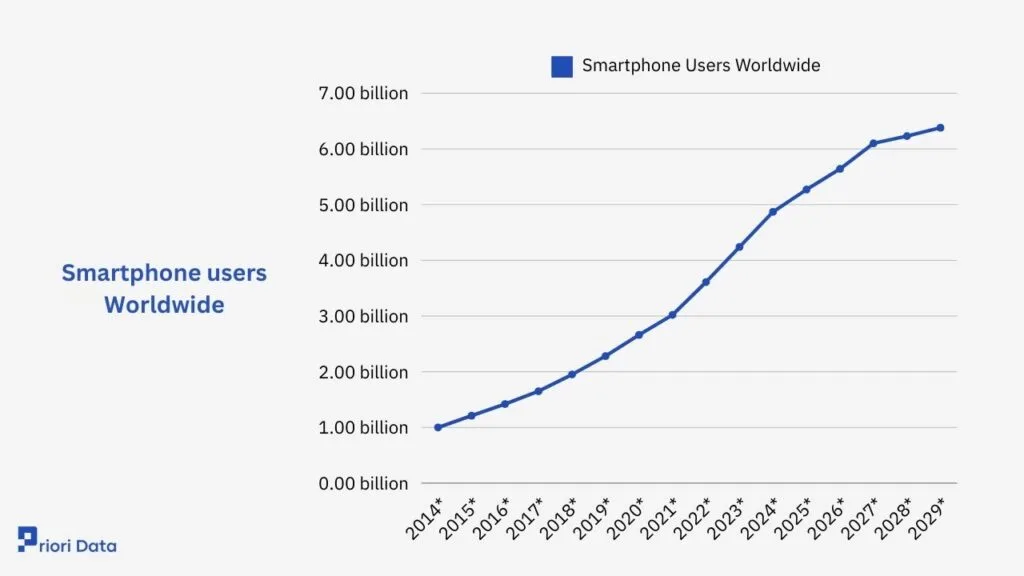
There were 7.47 billion smartphone subscriptions in the world at the end of 2025, according to Ericsson, on a planet of about 8.2 billion people (UN estimate). That does not mean 91% of humanity owns a smartphone. Subscriptions count SIM cards, and many people have two. The best count of actual people is the GSMA's 5.8 billion unique mobile subscribers, about 70% of the world's population, and not all of them use a smartphone.
This report sets out the figures that can be traced to a primary source: how many smartphones are in use, who owns one, how many are sold each year, who makes them and what runs on them. Every number carries its year and its source, and the sources are listed at the end.
Smartphone statistics: the key figures
- 7.47 billion smartphone subscriptions worldwide in 2025, out of 8.84 billion mobile subscriptions of all kinds. Ericsson forecasts 8.49 billion smartphone subscriptions by 2031.
- 5.8 billion unique mobile subscribers in 2025, around 70% of the global population, across 8.8 billion wireless connections (GSMA).
- 82% of people aged 10 and over own a mobile phone of any kind (ITU, 2025). Ownership passes 95% in high-income economies and is 53% in low-income ones.
- 1.26 billion smartphones were shipped in 2025, up 1.9% on 2024 (IDC). Apple shipped the most for the first time, with 247.8 million.
- Android runs 69.2% of the smartphones that visit websites and iOS 30.8% (StatCounter, September 2026).
- 91% of US adults own a smartphone, up from 35% in 2011 (Pew Research Center, 2025).
- 2.94 billion mobile subscriptions were on 5G at the end of 2025, about one in three. The total passed 3 billion in early 2026 (Ericsson).
How many people use a smartphone?
No organisation counts smartphone users directly, which is why the figures quoted around the web disagree with each other. Three different measurements get mixed up:
| Measure | Figure | What it counts | Source |
|---|---|---|---|
| Smartphone subscriptions | 7.47 billion (2025) | Active SIM subscriptions used in a smartphone. One person can hold several. | Ericsson Mobility Report |
| Unique mobile subscribers | 5.8 billion (2025) | Individual people with at least one mobile subscription, smartphone or not | GSMA, The Mobile Economy 2026 |
| Mobile phone owners | 82% of people aged 10+ (2025) | Survey-based share of individuals who own any mobile phone | ITU, Facts and Figures 2025 |
Put together, the number of people using a smartphone is somewhere between the 5.8 billion unique subscribers and the share of them who have moved on from a basic phone. A round figure of five billion smartphone users is defensible. Anything more precise is an estimate, and should be quoted as one.
Smartphones make up 85% of all mobile subscriptions (7.47 of 8.84 billion). The rest are basic and feature phones, which are still common in low-income markets.
Who owns a mobile phone, by region and income
The ITU's 2025 figures cover mobile phones of any kind, among people aged 10 and over.
| Group | Share owning a mobile phone |
|---|---|
| World | 82% |
| High-income economies | Over 95% |
| Upper-middle-income economies | Over 90% |
| Low-income economies | 53% |
| Africa | 66% |
| Men (global) | 87% |
| Women (global) | 78% |
Women are 10% less likely than men to own a mobile phone, a gap the ITU says has narrowed from 12% in 2022. In the Arab States, mobile ownership runs 14 percentage points ahead of internet use, and in Asia-Pacific 4 points ahead: many people own a phone they do not use to go online, which is one sign that it is not a smartphone.
Smartphone ownership in the United States
Pew Research Center has asked Americans about smartphones since 2011, when 35% of adults owned one. In its 2025 survey, 91% did, and 98% owned a mobile phone of some kind.
View as table
| Period | Value |
|---|---|
| 2011 | 35% |
| 2013 | 58% |
| 2015 | 69% |
| 2016 | 77% |
| 2019 | 81% |
| 2021 | 85% |
| 2023 | 90% |
| 2025 | 91% |
Source: Pew Research Center, mobile fact sheet (2025 survey)
Growth has flattened since 2021. The remaining gap is concentrated in specific groups:
| US adults, 2025 | Own a smartphone |
|---|---|
| Ages 18 to 29 | 97% |
| Ages 30 to 49 | 96% |
| Ages 50 to 64 | 90% |
| Ages 65 and over | 78% |
| Household income under $30,000 | 82% |
| Household income $100,000 or more | 97% |
| High school education or less | 84% |
| College graduates | 96% |
| Rural residents | 87% |
| Suburban residents | 93% |
One figure matters more to app developers than the rest: 16% of US adults are "smartphone-only" internet users, with no home broadband. For them the phone is not one screen among several. It is the only one, which is why mobile pages and apps that assume a laptop exists somewhere lose a sixth of the country.
How many smartphones are sold each year
IDC counts 1.26 billion smartphones shipped in 2025, 1.9% more than in 2024 and the first year Apple shipped more phones than Samsung in over 14 years.
View as table
| Period | Value |
|---|---|
| Apple | 247.8M |
| Samsung | 241.2M |
| Xiaomi | 165.3M |
| vivo | 103.9M |
| Oppo | 102.0M |
| Others | ~400M |
Source: IDC Worldwide Quarterly Mobile Phone Tracker, full-year 2025
| Vendor | 2025 shipments | Share | Change on 2024 |
|---|---|---|---|
| Apple | 247.8 million | 19.7% | +6.3% |
| Samsung | 241.2 million | 19.1% | +7.9% |
| Xiaomi | 165.3 million | 13.1% | -1.9% |
| vivo | 103.9 million | 8.2% | +2.7% |
| Oppo | 102.0 million | 8.1% | -2.7% |
2026 has been harder. Counterpoint Research reports the market fell 7% year on year in the second quarter of 2026 as a shortage of memory chips pushed up component prices. Samsung took 23% of shipments that quarter and Apple 21%, its highest second-quarter share, after Apple led a first quarter for the first time earlier in the year. Xiaomi's shipments fell 26%, because its cheaper models absorb rising memory costs worst. North America was the only region to grow.
Android and iOS market share
StatCounter measures operating systems by the phones that visit the websites it tracks. In September 2026 Android had 69.2% of mobile web traffic worldwide and iOS 30.8%. Everything else, including KaiOS feature phones, rounds to zero.
The split varies enormously by country, and the two platforms differ in what their users spend. Apple's installed base passed 2.5 billion active devices in January 2026, a figure that includes iPads, Macs and watches as well as iPhones. Google last gave an official figure for Android in 2021, when it said more than 3 billion devices were active.
5G and data use
Ericsson counted 2.94 billion 5G subscriptions at the end of 2025, one third of all mobile subscriptions, after 660 million were added during the year. The total was close to 3.3 billion by the second quarter of 2026. North America has the highest 5G penetration at 79%, followed by North East Asia at 60% and Western Europe at 54%. Ericsson expects 5G to overtake 4G as the most common technology by 2027 and to reach 6.4 billion subscriptions, two thirds of the total, by 2031.
The average smartphone used 22 GB of mobile data a month in 2025. Ericsson forecasts 42 GB a month by 2031. How that time is spent is covered in the reports on screen time and social media use.
What the numbers mean for app developers
- The global market is a replacement market. Smartphone subscriptions are growing 2% a year and shipments 1 to 2%, so new users come from the regions where ownership is lowest, led by Africa, where Android dominates and phones are cheap.
- In the US, nearly everyone under 50 has a smartphone. Growth comes from the over-65s, where ownership is 78% and rising, and from the 16% who rely on a phone alone.
- The 2026 memory shortage is raising phone prices and cutting shipments of budget Android models. Expect older and cheaper devices to stay in use longer, which argues against dropping support for old Android versions too early.
- Two thirds of subscriptions will be 5G by 2031, and data per phone is set to double. Video-heavy features that were risky on mobile data are becoming normal.
How these figures are counted
Ericsson's subscription counts come from operator reporting and its own modelling, published twice a year in the Ericsson Mobility Report; the figures above are from the November 2025 edition's key figures, with 2026 updates from the June 2026 edition. The GSMA's unique subscriber figure comes from GSMA Intelligence. The ITU's ownership shares come from national household surveys compiled for its Facts and Figures series. IDC and Counterpoint estimate shipments from supply-chain and channel data; the two do not always agree, so vendor figures are quoted from one source at a time. Pew's US figures are from a survey of 5,022 adults conducted between February and June 2025. StatCounter's share is of web traffic, not devices, so it under-counts phones that rarely browse the web.
FAQs
How many people have smartphones in the world?
Roughly five billion. There is no direct count: Ericsson reports 7.47 billion smartphone subscriptions for 2025, but many people hold more than one, and the GSMA counts 5.8 billion unique mobile subscribers, not all of whom use a smartphone.
What percentage of the world owns a smartphone?
The ITU reports that 82% of people aged 10 and over own a mobile phone of some kind, from over 95% in high-income countries to 53% in low-income ones. Smartphones account for 85% of mobile subscriptions, so smartphone ownership is somewhat below the 82% figure.
How many smartphones are sold each year?
About 1.26 billion in 2025, according to IDC, up 1.9% on 2024. Shipments have stayed between roughly 1.2 and 1.5 billion a year since 2015, and fell in the first half of 2026 as memory chip prices rose.
Which company sells the most smartphones?
Apple shipped the most in 2025, with 247.8 million units and a 19.7% share, just ahead of Samsung's 241.2 million. Samsung led again in the second quarter of 2026 with 23%, according to Counterpoint. Xiaomi, vivo and Oppo complete the top five.
Is Android or iOS more popular?
Android, by users: 69.2% of mobile web traffic worldwide comes from Android phones and 30.8% from iPhones (StatCounter, September 2026). In the US and other high-income markets the split is far closer.
Is the smartphone market declining?
In 2026, yes. After growing 1.9% in 2025, shipments fell 3% year on year in the first quarter of 2026 and 7% in the second, according to Counterpoint Research, as a shortage of memory chips pushed up prices. North America was the only region to grow in Q2 2026.
What is the best-selling phone in the world?
Counterpoint reports that the iPhone 17 series was the top-shipped phone model worldwide in the second quarter of 2026. By vendor, Samsung led that quarter with 23% of shipments and Apple followed with 21%, while Apple led for the full year 2025.
Sources
- Ericsson: Mobility Report key figures (November 2025 edition) and mobile subscriptions outlook (June 2026 edition)
- GSMA: The Mobile Economy 2026
- ITU: Facts and Figures 2025, mobile phone ownership
- IDC: worldwide smartphone forecast, December 2025, and full-year 2025 shipments as reported by GSMArena, March 2026
- Counterpoint Research: global smartphone market share, quarterly (Q2 2026)
- Pew Research Center: mobile fact sheet, survey of February to June 2025
- StatCounter: mobile operating system market share worldwide, September 2026
- Apple: installed base of 2.5 billion active devices, stated on the Q1 fiscal 2026 earnings call on January 29, 2026, as reported by MacRumors
- Google: 3 billion active Android devices, announced at Google I/O 2021
All figures were checked against the sources above on October 6, 2026.